Orders
Where requests from your storefronts arrive — finding one, reading it, and moving it through its statuses.
Orders in the sidebar is where everything placed on your storefronts lands. One list, all storefronts, newest first — this is the screen a duty manager keeps open.
The list
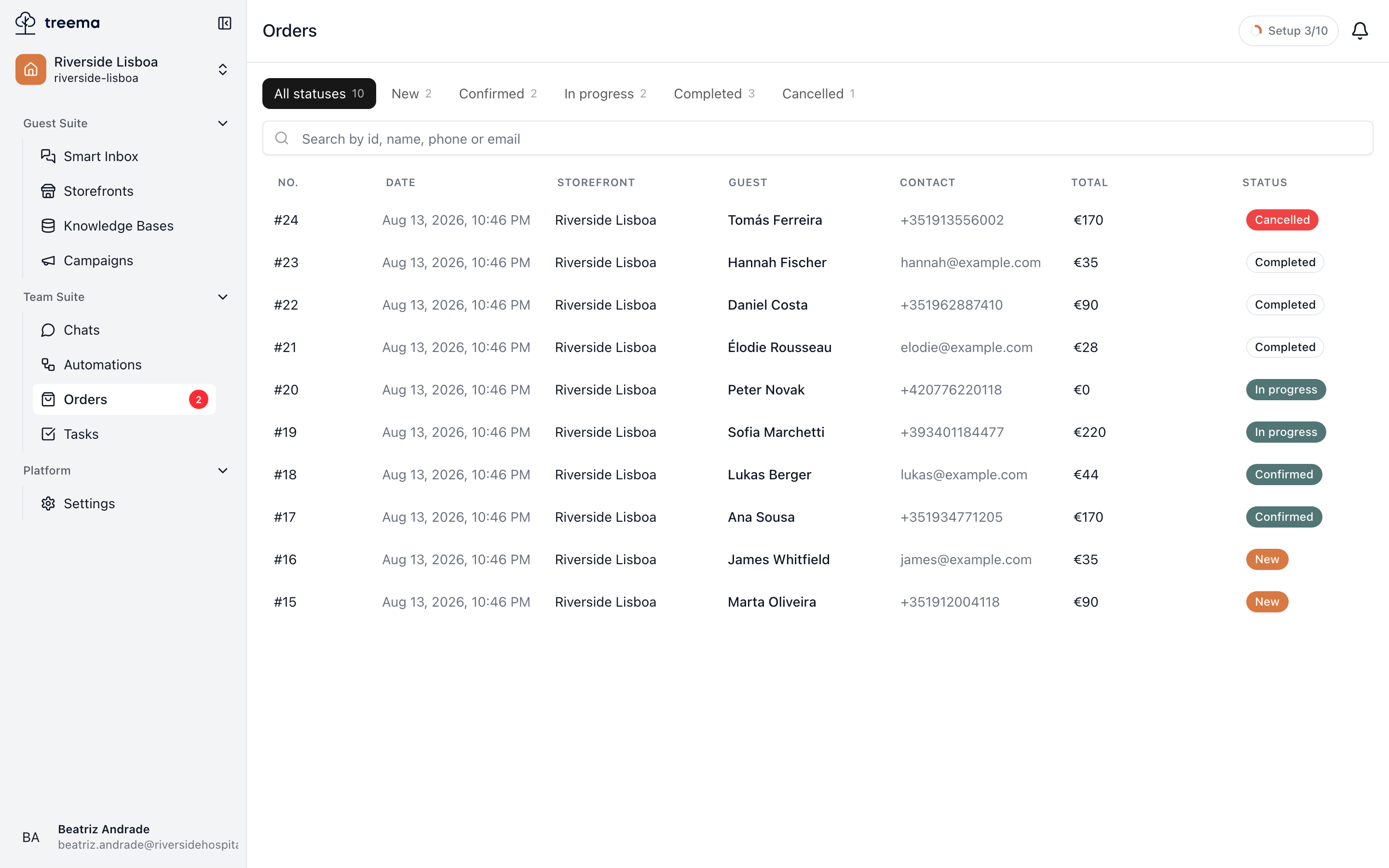
- 1
- 2
- Status tabs with counts, search, and the storefront filter
- Newest first, the order number in the first column
| Column | What it holds |
|---|---|
| No. | The order's number — short, and the one the guest was shown. First column on purpose. |
| Date | When it was placed. |
| Storefront | Which storefront it came from. |
| Guest | The name they gave. |
| Contact | The phone or email they left. |
| Total | The order's total, in that storefront's currency. |
| Status | Where it has got to — see below. |
Above the list are the tools for finding one order among many:
- Status tabs, each carrying a count, so "how many are still New" is answered without filtering.
- Search by number, name, phone or email — the field says so. A guest on the phone gives you any one of those, and any one is enough.
- Storefronts filter, for a workspace running several pages.
- Clear filters, once you've narrowed too far.
Your filters live in the page address, so a filtered view can be bookmarked or pasted to a colleague and it opens the same way for them.
If the list comes up short, check the filters before concluding that nothing was ordered — the page tells the two apart, and clearing them brings everything back.
Reading an order
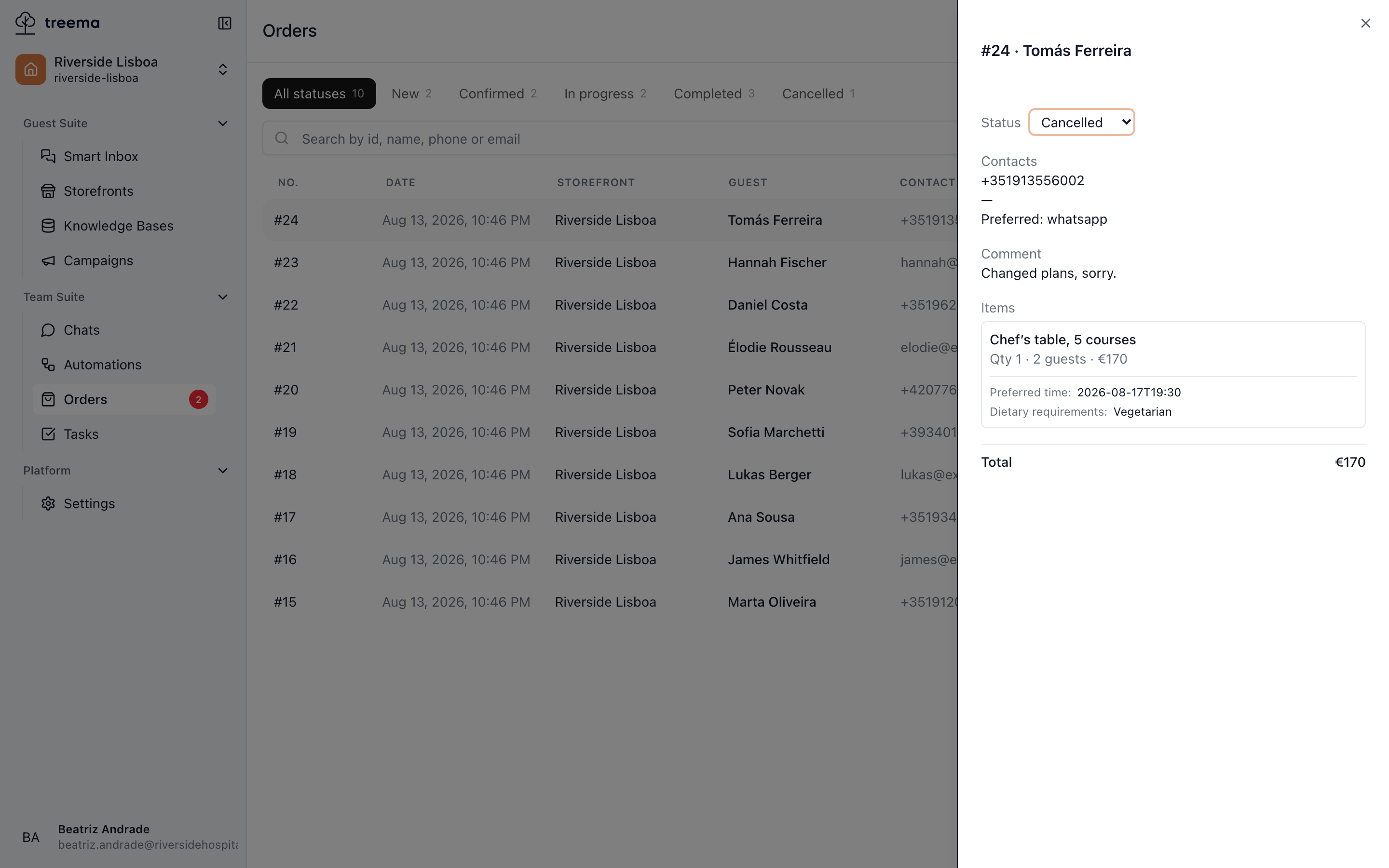
- 1
- Status, contacts, comment, and every line with its answers
Clicking a row opens the order beside the list:
- Status, as a dropdown — this is where it gets changed.
- Contacts — everything the guest left, and Preferred: the channel they asked to be contacted through. Use that one.
- Comment — their free text, if they wrote any.
- Items — each service with its quantity, the number of guests where the price is per person, and the answers to your custom fields underneath. The room number, the flight, the allergies — they're here, on the line they belong to, not in a separate place.
- Total.
Moving an order along
Five statuses, and they read as the life of a request:
| Status | Means |
|---|---|
| New | Just arrived. Nobody has looked at it. |
| Confirmed | You've accepted it and the guest can count on it. |
| In progress | Being carried out right now. |
| Completed | Done. |
| Cancelled | Not happening — by the guest or by you. |
Changing the dropdown saves immediately and confirms with "Order status updated". The guest sees the same status in their own list of requests, so moving an order to Confirmed is also how you tell them it's accepted, without writing a message.
Agree what Confirmed means before you go live
These statuses are a promise to the guest more than they are a filter for you. A team where Confirmed means "the spa has a slot booked" runs smoothly; one where somebody presses it to mean "I've seen this" produces guests who arrive expecting a treatment that was never scheduled. Decide, then tell the shift.
Who works with orders
Orders is the workspace owner's and admins' screen: they see every order and can move any of them along. Orders themselves follow the storefront's scope, so an order placed on a property's storefront belongs to that property.
The item carries a badge with the number of orders still sitting at New — the fastest way to notice that something came in while you were on another screen.
If Orders isn't in your sidebar
Orders is a module, and a module is switched on per workspace. While it is off the section is not merely hidden — nobody in that workspace can reach orders at all, the owner included.
A new workspace can sell before it can see what was sold
Storefronts is on for a new workspace out of the box; Orders is not. So a storefront can be published, and guests can place orders, while your team still has no screen to read them on — the orders are being recorded, not lost, but nobody is being shown them. If you have just published your first storefront, check that Orders is in your sidebar before you hand the link out.
Switching it on is not something you can do from inside the app: it is set for your workspace by the Treema HQ team. Write to support@treema.ai naming your workspace and ask for the Orders module to be enabled — it takes effect immediately, and every order placed while it was off is there waiting.